Competitor Tracking
Competitor Tracking: Compare Creative Output Across Meta Advertisers
Track competitor Meta ads — launch velocity, ad library, reach, and estimated spend. All from public data, no competitor account access needed. Free.
Founder, Wilow
·
September 3, 2026
Wilow's competitor tracking shows you how much creative your competitors are putting into market — and how fast they are testing it — set side by side against your own account. No competitor account access needed. Everything runs on public Meta Ad Library data.
There are three connected views: Competitor Velocity, the Competitor Ad Library, and Competitor Reach and Audience. Together they answer the three questions every performance marketer asks about their competitors: how much are they advertising, which ads are working, and how far are those ads actually reaching?
Competitor Velocity: who is testing the most creative?
Velocity is the view that gives the feature its name. A horizontal bar chart lists your own brand alongside every competitor you track, each bar showing the number of ads launched in your selected window and market. A checkbox on each row loads that brand into a timeline: your brand above the line, the competitor below, every ad a dot on its launch day. Circles are image ads. Triangles are video. The taller the column, the more ads launched that day.
Hover any dot to preview the creative with a short label and how long it has been running. The timeline makes testing cadence visible: a competitor shipping twenty new ads in a week looks different from one running five. A competitor whose dots cluster around a single day did a launch push. A competitor whose dots spread evenly across the month is running a steady testing programme. These are strategic signals you cannot get from a ranked list or a spend estimate.
Velocity currently covers Meta only. YouTube and LinkedIn were evaluated and parked — YouTube returns no playable creative and LinkedIn cannot be searched by advertiser — but the visual encoding deliberately leaves room for more platforms when the data supports them.
Competitor Ad Library: your own, friendlier view of any brand's ads
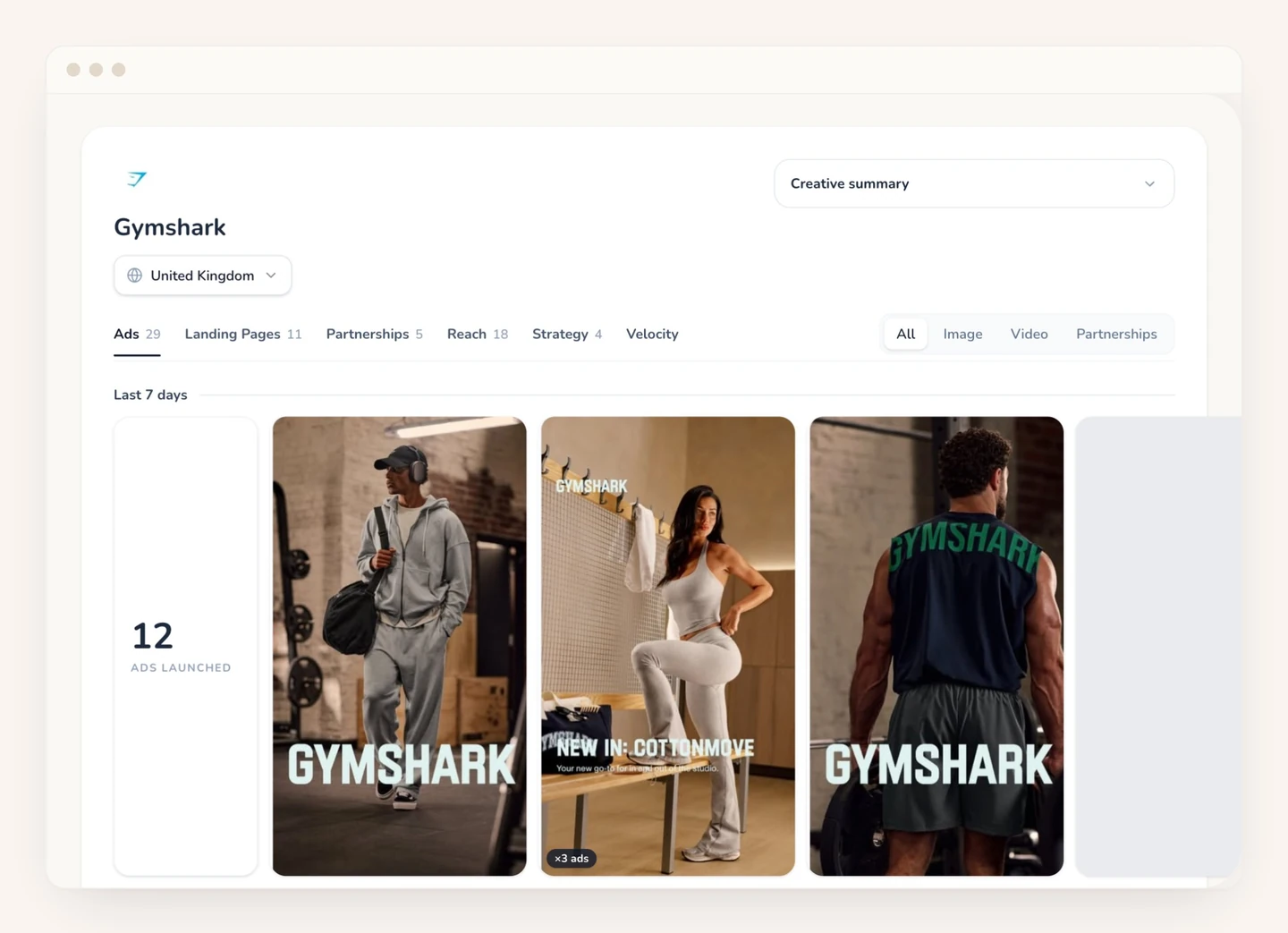
Where Meta's own Ad Library is a flat, timeless grid, Wilow's Competitor Ad Library organises any tracked brand's ads by recency so testing cadence and proven winners are obvious at a glance. Open a competitor and you see:
- A weekly feed — active ads grouped into four trailing seven-day slices (last 7, 14, 21, and 28 days), newest first, each slice pinned with a count and a horizontally scrolling row of creatives from that week.
- A "Live for 90+ days" row — ads that have been running three months or more, tagged with their days-live and ordered longest-running first. Meta keeps what performs, so longevity is the honest signal of what is actually working for a competitor.
- A landing-pages Sankey diagram — maps the flow from a brand's ads to the destinations they point to, ribbon width proportional to how many ads point at each page. See at a glance whether a competitor is sending traffic to a product page, a collection, a lead form, or a homepage.
Filter by format (image or video) and by market. Click any creative to open its detail — full creative, ad copy, call-to-action, landing-page URL, and how long it has been running. The library loads ads on demand rather than eagerly syncing every tracked competitor, so credits are not burned pulling data for a brand no one looks at.
Competitor Reach and Audience: how far are their ads actually going?
Reach figures come from Meta's own public disclosures, published for ads shown in the EU and the UK. Select a competitor and a market, any EU country or the UK, and Wilow shows:
- Reach: how many people saw the competitor's ads in that market.
- Estimated spend: a modelled figure driven by a single CPM slider. Meta publishes reach but not spend, so Wilow infers spend from it. The slider defaults to $15 CPM — you can dial it to your own read of a market rather than trusting a single hard-coded guess.
- Demographics: when Meta measured the ad's audience, an age-and-gender bar chart sits beneath the reach figures. When it did not, the chart is simply absent rather than shown empty.
The spend slider is the honest part. Spend is a modelled figure, not a reported one. Making the CPM adjustable rather than fixed means a marketer can apply their own market knowledge rather than accept a guess. An ad with no qualifying reach data shows no spend estimate at all — nothing is built on nothing.
For the full method, from Meta's transparency panel to a spend range you can defend, read how to find a competitor's Facebook ad spend, which walks through a real ad step by step and shows any brand's delivered reach for free.
How competitor tracking fits into a weekly workflow
Monday morning: open Competitor Velocity. Look at the bar chart. Has any competitor launched significantly more ads than usual? That is a campaign push — worth knowing about before your weekly team standup.
After your own sync: open the Competitor Ad Library for your closest rival. Scroll to the "Live for 90+ days" row. Study the ads that survived. What format are they? What hook opens them? Those are the patterns your competitor has landed on. Apply the pattern to your own brand, not the execution.
Before a campaign launch: check Competitor Reach and Audience for the brand whose market you are entering. What is their estimated reach? What demographics are their ads hitting? That context shapes your own targeting and budget decisions.
How is this different from an ad spy tool?
Ad spy tools like BigSpy and Minea show you competitor ads so you can find creative inspiration. They are search engines for ad creative — type a keyword, browse results, save what you like. Wilow's competitor tracking does something different: it compares your creative output against specific tracked competitors over time, in a structured view that shows velocity, longevity, and reach. It is competitor intelligence, not ad search. The two are complementary — many Wilow users run both.
Pricing
Competitor tracking is free on Wilow, apart from pulling a competitor's delivered reach figures, which costs 2 credits each time Wilow fetches new reach for a brand in a market. Track as many competitors as you want on either plan — the per-tier cap on tracked competitors has been removed. Everything runs on public data, so no competitor has to connect their account and you need no permissions beyond your existing Meta access. Connect your own account to compare your creative output against your competitors side by side. No credit card required.